
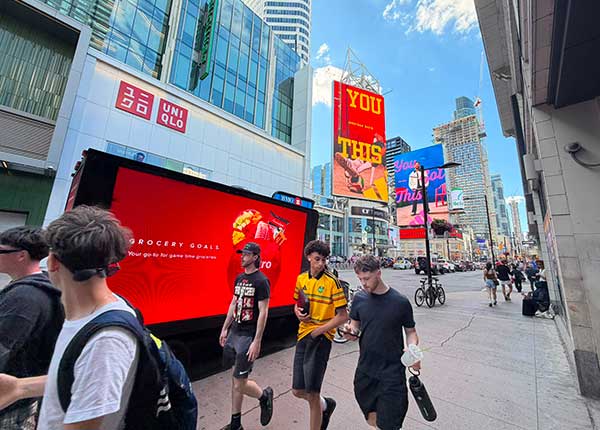
Billboard advertising is a form of out-of-home (OOH) advertising that uses large-format printed or digital displays to promote brands, products, services and events in public spaces. In Canada, the three main types of billboard ads are traditional static billboards, fixed digital billboards and mobile LED billboards.
- Static billboard ads: Ideal for long-term brand visibility at fixed locations.
- Digital billboard ads: Offer flexible creative updates and shared advertising opportunities.
- Mobile billboard ads: Reach targeted neighbourhoods, commercial districts and event audiences through planned routes.
- Advertising costs: Vary by location, format, campaign duration and audience exposure. Grow More’s standard dedicated mobile LED billboard campaigns typically range from CAD $1,200 to $2,000 per day.
- Audience reach: A mobile LED billboard truck can generate an estimated 50,000+ impressions per day under suitable campaign conditions.
Grow More Technology Group Corp. provides GPS-tracked digital LED mobile billboard advertising across 70+ Canadian cities, helping businesses, national brands and advertising agencies reach real-world audiences through flexible campaign planning, execution and performance reporting.
Think about the last time you drove through downtown Toronto, walked along a busy street in Vancouver or attended a major event in Calgary. Chances are, you noticed a billboard advertising a new product, an upcoming concert, a local restaurant or a brand you recognized.
You didn’t have to open an app, search for a product or click on a website. The advertisement was simply there, becoming part of your everyday surroundings.
That is one of the biggest advantages of billboard advertising.
Even in a world dominated by smartphones, social media and online advertising, billboard ads continue to give businesses a way to connect with people in the physical world. From traditional roadside billboards to digital screens and mobile LED billboard trucks, outdoor advertising has evolved into a flexible marketing medium for businesses of almost every size.
But how does billboard advertising actually work? How much does it cost in Canada? And which type of billboard is right for your business?
This guide explores the different types of billboard advertising, their benefits, costs, real Canadian campaign examples and everything you need to know before launching your first campaign.
What Is Billboard Advertising?
Billboard advertising is a form of out-of-home (OOH) advertising that uses large-format displays in public spaces to promote businesses, products, services, events and public awareness messages.
Billboard ads are commonly placed along highways, busy roads, shopping districts, commercial areas, entertainment venues and other locations where people travel, work, shop and gather.
Unlike online advertisements, which appear on personal devices, billboard advertising reaches audiences in shared physical environments.
Modern billboard advertising generally falls into three main categories:
- Static billboard advertising: Printed advertisements displayed at fixed locations.
- Digital billboard advertising: Electronic LED displays that can show and rotate digital advertisements.
- Mobile billboard advertising: Advertising displays mounted on vehicles that travel through selected locations.
Together, these formats give advertisers different ways to reach consumers depending on their audience, budget, location and marketing objectives.
How Do Billboard Ads Work?
The concept behind billboard advertising is relatively straightforward. A business purchases advertising space or screen time to display its message in locations where its intended audience is likely to see it.
However, the way a billboard campaign operates depends on the advertising format.
A traditional billboard displays the same printed advertisement throughout the booking period. A digital billboard may rotate several advertisements throughout the day. A mobile billboard travels through selected neighbourhoods, commercial districts or event locations, bringing the advertisement closer to its intended audience.
A typical billboard advertising campaign involves:
- Identifying the target audience and campaign objectives.
- Selecting suitable billboard locations or mobile advertising routes.
- Choosing the advertising format and campaign duration.
- Designing the billboard advertisement.
- Launching and monitoring the campaign.
- Reviewing estimated audience exposure and campaign performance.
The goal is not simply to display an advertisement. It is to place the right message in front of the right audience at the right time.
For a closer look at electronic displays and advertising technology, read our guide on how digital billboards work.
What Are the Different Types of Billboard Advertising?
Not all billboards serve the same purpose. Some are designed to build long-term brand recognition, while others are better suited to short-term promotions, product launches and event marketing.
Understanding the differences can help businesses make better advertising decisions.
1. Traditional Static Billboard Advertising
Traditional billboards are the large printed advertisements commonly seen along highways, major roads and commercial corridors.
These billboards usually display one advertiser’s message for an agreed period, often several weeks or months.
Static billboard ads are particularly useful for businesses that want consistent visibility in a specific location.
Common applications include:
- Real estate developments.
- Automotive dealerships.
- Restaurants and retail businesses.
- Long-term brand awareness campaigns.
- Directional advertising near business locations.
Their main advantage is continuous visibility at an established location. However, once the advertisement is installed, changing the message generally requires new printing and installation.
For businesses targeting commuters and motorists, highway billboard advertising remains an established outdoor marketing option.
2. Digital Billboard Advertising
Digital billboard advertising uses electronic LED screens to display advertisements without requiring printed materials.
These screens can rotate multiple advertisements, allowing different businesses to share the same advertising location.
Depending on the screen, media operator and local regulations, advertisers may be able to schedule different messages throughout the day or update their creative during a campaign.
Digital billboard ads are well suited for:
- Seasonal promotions.
- Time-sensitive advertising.
- Product announcements.
- Retail sales.
- Entertainment and event promotions.
- Brand awareness campaigns.
For example, a restaurant could advertise breakfast in the morning and dinner specials later in the day, provided its media booking supports scheduled creative changes.
Digital billboards offer greater creative flexibility than traditional printed billboards, although advertisers should understand how much screen time their booking includes.
Learn more about how many ads can run on a digital billboard.
3. Mobile Billboard Advertising
Mobile billboard advertising takes outdoor advertising beyond a fixed location.
Instead of waiting for audiences to pass a billboard, mobile advertising vehicles travel through locations where the intended audience is likely to be.
Mobile billboards can feature printed advertising panels or high-resolution digital LED screens. Digital LED billboard trucks can display images, animated graphics and video, subject to applicable operating requirements and local regulations.
This format is particularly useful when businesses want to reach multiple locations within a single campaign.
A mobile billboard campaign could begin in a downtown business district, move through a shopping area during the afternoon and finish near an entertainment venue during an evening event.
Mobile billboard ads are commonly used for:
- Grand openings and store launches.
- Concerts, festivals and sporting events.
- Real estate promotions.
- Product launches.
- Community awareness campaigns.
- Multi-city advertising.
- Experiential marketing activations.
The flexibility to adjust routes, locations and campaign schedules makes mobile billboard advertising especially attractive for short-term and location-specific marketing.
Explore our complete guide to mobile digital billboard advertising in Canada for more information.
4. 3D and Anamorphic Billboard Advertising
Anamorphic billboard advertising uses specially designed visual content to create the illusion of three-dimensional depth when viewed from a suitable angle.
These advertisements can make products appear to extend beyond the screen or interact with the surrounding environment.
Although often associated with large digital displays in major city centres, anamorphic creative can also be adapted for compatible mobile LED displays.
The effectiveness of this format depends heavily on screen configuration, viewing angles and creative production.
It is particularly suitable for product launches, entertainment promotions and campaigns designed to generate attention and social media engagement.
Read more about anamorphic LED truck advertising in Canada.
5. Shared and Programmatic Billboard Advertising
Businesses do not always need to purchase exclusive advertising space.
Shared billboard advertising allows multiple advertisers to rotate their messages on the same digital screen or mobile LED billboard truck.
This can make outdoor advertising more accessible to businesses that do not require a dedicated campaign.
Programmatic digital out-of-home advertising, commonly known as pDOOH, takes this approach further by using automated media-buying technology to purchase eligible digital advertising inventory.
Depending on the platform, advertisers may select locations, schedules, audience criteria or other campaign conditions.
Shared advertising and programmatic advertising are not necessarily the same thing, but both can offer alternatives to traditional exclusive billboard bookings.
Comparing the Different Types of Billboard Ads
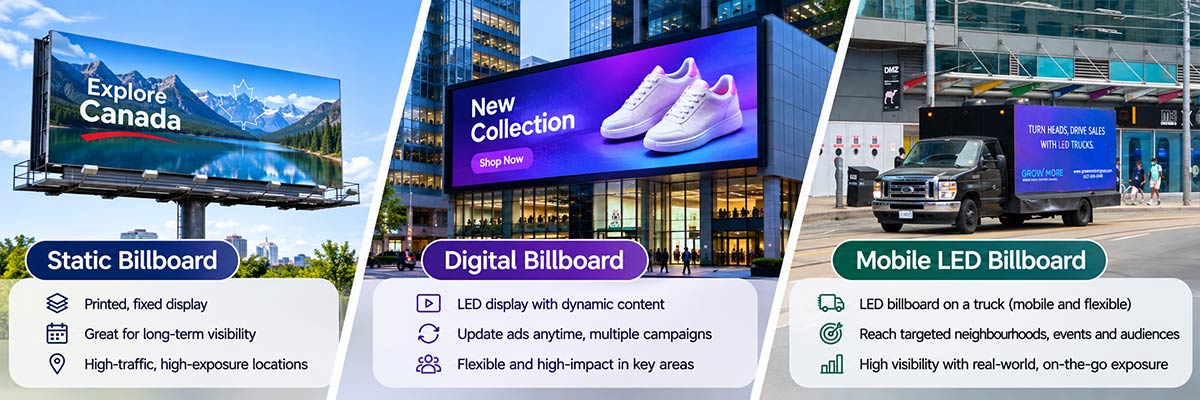
The best billboard format depends on what a business wants to achieve.
| Advertising Feature | Static Billboards | Digital Billboards | Mobile LED Billboards |
|---|---|---|---|
| Advertising location | Fixed | Fixed | Multiple locations |
| Creative format | Printed graphics | Digital graphics and supported motion | Images, animation and video where permitted |
| Creative updates | Requires replacement | Digital updates | Digital updates |
| Audience targeting | Location-based | Location and schedule-based | Route, location and schedule-based |
| Typical campaign duration | Weeks or months | Flexible | Hours, days, weeks or months |
| Advertising exclusivity | Typically exclusive | Often shared | Dedicated or shared |
| Event-specific advertising | Location dependent | Location dependent | Highly adaptable |
| Campaign measurement | Estimated audience exposure | Estimated impressions and available platform data | GPS routes and estimated impressions where supported |
| Best suited for | Long-term local visibility | Flexible advertising at established locations | Targeted activations and multi-location campaigns |
There is no single billboard format that works best for every business.
A real estate developer promoting a project for several months may benefit from a fixed billboard near the development. A retailer announcing a weekend sale may prefer a mobile LED billboard that reaches multiple shopping districts.
Some businesses may achieve better results by combining different formats.
For a more detailed comparison, explore mobile billboards vs static billboards vs online ads.
Why Is Billboard Advertising Still Effective?
With businesses investing heavily in digital marketing, it is reasonable to ask whether billboard advertising still has a place in modern advertising strategies.
The answer lies in how people experience advertising outside their digital devices.
Real-World Brand Visibility
Billboards place brands directly into the environments where people spend their time.
Whether someone is commuting to work, shopping, attending an event or walking through a neighbourhood, billboard ads can create opportunities for brand exposure without requiring an online search.
Repeated Exposure
A commuter travelling along the same road every day may encounter the same billboard repeatedly.
Similarly, a mobile billboard operating throughout a selected commercial district can create multiple opportunities for audiences to see a brand’s message.
Repeated exposure can support brand familiarity and recognition over time.
No Dependence on Clicks or Online Ad Blockers
Physical billboard ads are not dependent on website visits, social media feeds or browser-based advertising systems.
While people can still overlook an outdoor advertisement, conventional online ad-blocking software cannot remove a physical billboard from their surroundings.
Local Market Relevance
One of the strongest advantages of billboard advertising is its ability to connect marketing messages with physical locations.
A restaurant can advertise near its neighbourhood. A retailer can promote a new store opening within surrounding communities. An event organizer can reach audiences near entertainment districts and venues.
This connection between advertising and location can make a campaign more relevant.
Support for Digital Marketing
Billboard advertising does not need to compete with online advertising.
A person may first discover a brand through a billboard and later search for it online, visit its website or engage with its social media content.
Combining outdoor advertising with search advertising, social media and other digital marketing channels can create a more connected customer journey.
What Are the Limitations of Billboard Advertising?
Like any marketing channel, billboard advertising has limitations.
People may only have a few seconds to read an advertisement. This makes billboards less suitable for lengthy explanations or complicated product information.
Outdoor advertising also relies heavily on location, audience movement, visibility and creative quality. A poorly positioned billboard or an advertisement with too much text may deliver limited value, regardless of its size.
Other considerations include:
- Estimated impressions do not necessarily represent unique individuals.
- Audience attention cannot always be directly measured.
- Sales and conversions may be difficult to attribute to a single billboard.
- Weather, traffic and physical obstructions can affect visibility.
- Municipal regulations may restrict certain advertising formats or operating locations.
Successful billboard marketing begins with realistic objectives and a clear understanding of what the medium can deliver.
How Much Does Billboard Advertising Cost in Canada?
Billboard advertising costs in Canada vary considerably depending on the advertising format, city, location, campaign duration and expected audience exposure.
A billboard in a high-demand downtown Toronto location will generally have different pricing from a billboard in a smaller regional market.
Similarly, booking a shared digital advertising slot is different from hiring a dedicated mobile LED billboard truck.
The main factors affecting billboard advertising costs include:
- Geographic location and market demand.
- Billboard size and advertising format.
- Campaign duration.
- Traffic levels and audience exposure.
- Exclusive or shared advertising arrangements.
- Creative production and installation requirements.
- Seasonal demand and major events.
Traditional static billboards are commonly priced by multi-week booking periods. Fixed digital billboards may be purchased through scheduled advertising slots or impression-based media arrangements.
Mobile billboard advertising is generally available through hourly, daily, weekly or monthly campaign packages.
At Grow More Technology Group, dedicated mobile LED billboard advertising campaigns typically start from CAD $1,200 to $2,000 per day for standard bookings. Premium events, specialized deployments, extended operating hours and long-distance travel may increase campaign costs.
Shared mobile billboard advertising can provide a lower-cost alternative when available.
The important consideration is not simply how much a billboard costs, but whether the campaign reaches an audience that is relevant to your business.
For detailed pricing information, explore:
Which Type of Billboard Advertising Is Right for Your Business?
Before purchasing billboard advertising, consider what you want people to do after seeing your advertisement.
Are you trying to build awareness? Encourage store visits? Promote an upcoming event? Introduce a new product?
Different objectives require different advertising approaches.
| Campaign Objective | Suitable Billboard Format |
|---|---|
| Long-term brand recognition | Static or fixed digital billboards |
| Grand opening or store launch | Mobile LED billboards |
| Highway commuter exposure | Static or fixed digital billboards |
| Weekend retail promotion | Mobile or fixed digital billboards |
| Concert or festival promotion | Mobile LED and fixed digital billboards |
| Product launch | Digital or mobile LED billboards |
| Real estate development | Static and mobile billboards |
| Multi-city brand awareness | Mobile and fixed billboard networks |
| Flexible creative updates | Digital and mobile LED billboards |
| Limited advertising budget | Shared digital or mobile billboard advertising |
For many businesses, the strongest approach may involve using more than one advertising format.
A national retailer, for example, could maintain fixed billboard advertising in major markets while deploying mobile LED billboard trucks during store openings and promotional events.
Real Billboard Advertising Examples from Canadian Campaigns
The value of billboard advertising becomes clearer when we look at how businesses use it in real marketing situations.
Through our mobile LED billboard campaigns across Canada, Grow More Technology Group has worked with businesses across travel, technology, retail, entertainment, real estate and other industries.
Here are several examples of how billboard ads can support different marketing objectives.
Skyscanner: Bringing Travel Advertising into Busy Urban Areas

Travel advertising is often associated with online searches, booking platforms and social media.
Skyscanner extended its brand visibility into the physical world through mobile digital billboard advertising in Canadian urban environments, including Hamilton and downtown Kitchener, Ontario.
By bringing travel-related advertising into busy public areas, the campaign created additional opportunities for consumers to discover and recognize the brand during their everyday activities.
Explore the Skyscanner mobile billboard advertising campaign.
Samsung Galaxy Z Fold: Product Promotion Through Digital Billboard Ads
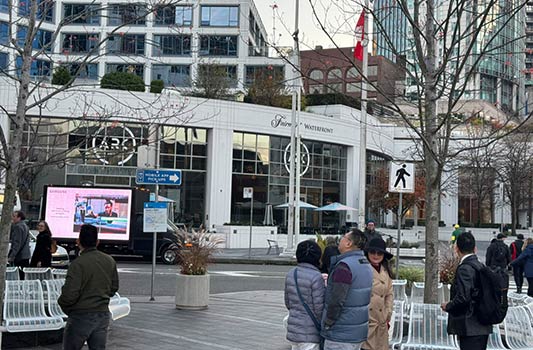 Technology products often benefit from visual advertising that highlights their design and features.
Mobile LED billboard campaigns promoting the Samsung Galaxy Z Fold in Toronto and Vancouver demonstrated how digital outdoor advertising can bring product messaging into busy urban environments.
High-resolution LED screens allowed the campaign to showcase product-focused creative while reaching audiences across selected locations.
This approach can complement online product launches and traditional retail marketing.
Retail Store Openings: Reaching Customers Beyond the Storefront
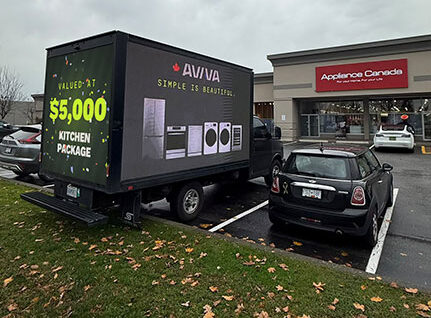
A new store may have an attractive showroom, strong products and a well-planned opening event. However, people still need to know that the business exists.
Mobile billboard advertising can help extend the visibility of a store opening beyond its immediate storefront.
Through campaigns involving showroom activations and retail promotions in Richmond and Vancouver, Grow More has used a combination of stationary advertising and mobile routes to reach surrounding commercial areas.
The flexibility to operate near a business and then travel through nearby communities makes this approach useful for local retail marketing.
Read our guide on mobile billboard advertising for store openings.
Real Estate Advertising: Promoting Homes in Brooklin and Whitby
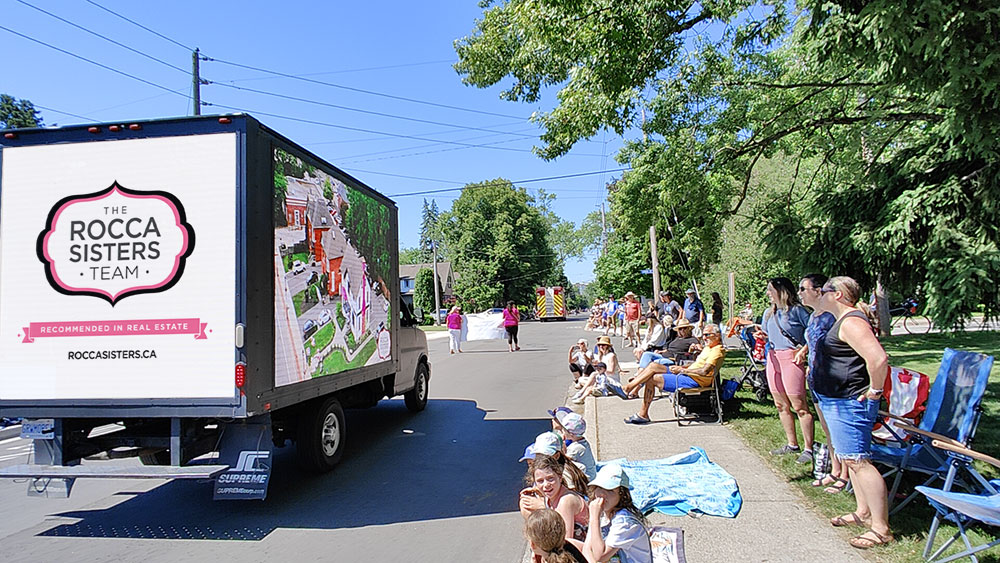
Real estate marketing depends heavily on reaching people within relevant geographic areas.
For a residential development promoting townhomes and detached homes in Brooklin, mobile LED billboard advertising was used to support local awareness and encourage prospective buyers to visit the development.
Following the promotional weekend, the client reported that sales associated with Brooklin were five times their usual weekend level.
The client also praised the execution of a separate activation at St. Jacobs Market.
While these results cannot be attributed exclusively to billboard advertising, they demonstrate how location-focused outdoor campaigns can complement broader real estate marketing efforts.
Korea Tourism: Extending Brand Awareness Across Multiple Markets
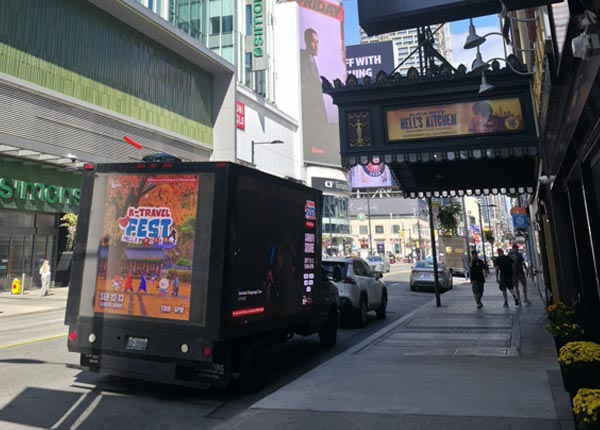
Tourism campaigns often need to reach audiences across several locations rather than focus on a single neighbourhood.
Mobile billboard advertising provides tourism organizations with the flexibility to introduce destination-focused messages across different urban environments.
Grow More’s work with Korea Tourism illustrates how outdoor advertising can form part of a broader destination awareness strategy, bringing travel inspiration into public spaces.
These campaigns demonstrate an important point: effective billboard advertising is not limited to one industry, one audience or one type of business.
What Makes Billboard Ads Effective?
Keep the Message Simple
Focus on one central message. Whether you are promoting a sale, announcing an event or introducing a brand, the audience should understand the purpose of the advertisement quickly.Make the Advertisement Easy to Read
Use clear typography, strong contrast and appropriately sized text. Creative designed for a smartphone or printed brochure may not automatically work well on a billboard. The advertisement should be designed specifically for its viewing distance and display format.Use Strong Visuals
A recognizable product image, compelling photograph or distinctive brand graphic can often communicate more effectively than several lines of text. Digital billboard ads may also use animation or video where permitted, but motion should support the message rather than distract from it.Include a Clear Call to Action
Tell people what to do next. This could be visiting a nearby store, attending an event, searching for a brand online or remembering a simple website address. For pedestrian-focused or stationary advertising, a QR code may also be useful. However, advertisements should never encourage drivers to interact with their phones while driving.Match the Creative to the Location
An advertisement near a shopping centre may need a different message from one displayed near a stadium or business district. The more relevant the message is to its surroundings, the more useful the advertising opportunity can become.How to Measure Billboard Advertising Performance
One of the most common questions businesses ask is whether billboard advertising can be measured.
Although outdoor advertising works differently from online advertising, modern measurement tools can provide useful insights into campaign delivery and potential audience exposure.
Billboard Advertising Impressions
An impression represents an estimated opportunity for someone to see an advertisement.
Depending on the billboard format and measurement methodology, impression estimates may consider:
- Traffic volumes.
- Pedestrian activity.
- Advertising locations.
- Campaign operating hours.
- Audience movement.
- Display visibility and exposure assumptions.
Impressions should not automatically be interpreted as confirmed views or unique individuals.
Grow More’s mobile LED billboard campaigns use GPS-based campaign reporting and estimated audience exposure data to help advertisers understand where their advertisements operated and their potential reach.
Under suitable campaign conditions, a mobile LED billboard truck may generate an estimated 50,000 or more impressions per day. Actual estimates vary by location, route, operating hours and audience activity.
Read our detailed explanation of how mobile billboard impressions are calculated.
Cost Per Thousand Impressions (CPM)
CPM is a common advertising metric used to estimate the cost of generating 1,000 impressions.
The formula is:
CPM = (Total Advertising Cost ÷ Estimated Impressions) × 1,000
For example, consider a billboard advertising campaign costing CAD $1,500 and generating an estimated 50,000 impressions.
| Campaign Metric | Illustrative Value |
|---|---|
| Campaign investment | $1,500 |
| Estimated impressions | 50,000 |
| Estimated CPM | $30 |
This is an illustrative calculation, not a guaranteed campaign result.
CPM can help businesses compare advertising opportunities, although differences in measurement methodology should be considered when comparing outdoor and online advertising.
Measuring Business Outcomes
Beyond impressions, advertisers can evaluate other indicators of campaign performance, including:
- Website traffic during the campaign.
- Branded search activity.
- Store visits.
- Customer enquiries.
- Promotional code usage.
- Sales activity.
- Social media engagement.
- Customer feedback.
Using dedicated landing pages, memorable promotional codes or campaign-specific offers can help businesses better understand how outdoor advertising contributes to their wider marketing activities.
How to Advertise on a Billboard in Canada
Launching a billboard advertising campaign does not need to be complicated.
Whether you are a small business purchasing outdoor advertising for the first time or a national brand planning a multi-city campaign, the following steps can help.
Step 1: Define Your Advertising Objective
Start by identifying what you want the campaign to accomplish.
A campaign focused on brand awareness will require a different approach from one designed to promote a three-day retail sale.
Step 2: Identify Your Target Audience
Consider where your potential customers live, work, shop and spend their time.
Understanding audience behaviour can help determine which locations, routes and advertising schedules are most appropriate.
Step 3: Choose the Right Billboard Format
Decide whether static, digital or mobile billboard advertising best supports your objectives.
Consider whether you need long-term visibility, flexible creative updates or the ability to reach multiple locations.
Step 4: Establish Your Campaign Budget
Determine how much you want to invest and whether your campaign requires dedicated advertising or a shared advertising arrangement.
Remember to consider any applicable creative production, installation, travel and operational expenses.
Step 5: Prepare Your Billboard Advertisement
Create advertising material that meets the technical requirements of your selected billboard.
Keep your message clear, visually appealing and appropriate for the viewing environment.
Step 6: Select Locations and Campaign Dates
Choose locations and dates based on audience activity, business objectives and relevant events.
For mobile advertising, route planning can help align campaign delivery with shopping periods, commuter activity and event schedules.
Step 7: Launch, Monitor and Review
Once the campaign begins, review the available reporting and monitor relevant business indicators.
Use these insights to improve future advertising decisions.
For businesses considering a dedicated mobile campaign, our guide on how to plan an 8-hour mobile billboard advertising campaign in Canada provides a practical starting point.
Billboard Advertising for Small Businesses and National Brands
There is a common misconception that billboard advertising is only suitable for large corporations with substantial marketing budgets.
While premium advertising locations can require significant investment, the availability of different billboard formats and flexible booking options has created opportunities for businesses of various sizes.
Billboard Advertising for Small Businesses
Local businesses often benefit from concentrating their advertising within a specific geographic area.
A restaurant, dental clinic, fitness centre, retail store or local service provider may not need national exposure. Instead, it may need greater recognition among people living and working nearby.
Short-term mobile billboard campaigns and shared digital advertising can help businesses explore outdoor advertising without necessarily committing to long-term bookings.
Billboard Advertising for National Brands
National brands often need consistent messaging across several cities or provinces.
A combination of fixed billboard networks, digital advertising and mobile LED billboard campaigns can support product launches, seasonal promotions and regional marketing initiatives.
Mobile advertising can also help national brands adapt campaign delivery to local events, retail locations and audience activity.
Billboard Advertising for Agencies and Media Buyers
Advertising agencies can use billboard advertising to extend their clients’ marketing strategies beyond digital channels.
Working with an outdoor advertising partner can provide access to campaign planning, creative specifications, advertising inventory, execution and reporting.
Grow More also works with advertising agencies and media buyers looking to manage or resell mobile LED billboard advertising services for their clients.
Explore how our billboard advertising services for agencies and media buyers can support your clients through campaign planning, nationwide execution, reporting and long-term advertising partnerships.
Where Can You Run Billboard Ads in Canada?
Billboard advertising is available across major Canadian cities, suburban communities and regional markets.
However, the most suitable locations depend on the intended audience and campaign objectives.
| Canadian Market | Potential Advertising Opportunities |
|---|---|
| Toronto and the GTA | Downtown districts, shopping centres, entertainment venues and commuter corridors |
| Vancouver and the Lower Mainland | Commercial districts, waterfront areas, retail communities and urban events |
| Calgary | Business districts, shopping destinations, exhibitions and major events |
| Edmonton | Entertainment districts, retail areas and community events |
| Ottawa | Government districts, commercial areas, conventions and festivals |
| Montreal | Urban shopping districts, entertainment areas and cultural events |
| Winnipeg | Commercial corridors, sporting events and retail destinations |
| Halifax | Downtown areas, waterfront districts and community events |
| Quebec City | Tourism districts, cultural festivals and commercial areas |
| Victoria | Retail communities, tourism destinations and local events |
Grow More Technology Group operates mobile LED billboard advertising campaigns across more than 70 Canadian cities, supporting both local and multi-market advertising initiatives.
Businesses should also consider applicable municipal regulations, parking requirements and advertising restrictions when planning their campaigns.
Our guide to digital mobile billboard advertising rules in Canada provides additional information.
The Future of Billboard Advertising
Billboard advertising has evolved considerably from its traditional printed format.
Today’s outdoor advertising industry includes high-resolution digital displays, automated media buying, GPS-enabled mobile campaigns, dynamic creative and more advanced audience measurement.
The next stage of billboard advertising is likely to focus increasingly on flexibility, relevance and integration with other marketing channels.
Advertisers are exploring opportunities such as:
- Dynamic advertisements based on time and campaign conditions.
- Programmatic digital out-of-home media buying.
- Location-based campaign planning.
- Anamorphic and immersive advertising creative.
- Integration with digital marketing and experiential activations.
- Improved audience exposure measurement and reporting.
However, technology alone does not make an advertisement effective.
The fundamental principles remain the same: understand your audience, choose relevant locations, communicate a clear message and create an advertisement people can remember.
Frequently Asked Questions About Billboard Advertising
What is billboard advertising?
Billboard advertising is a form of out-of-home advertising that uses large-format printed or digital displays in public spaces to promote businesses, products, services and events.
How do billboard ads work?
Businesses purchase advertising space or screen time on static, digital or mobile billboards. Their advertisements are displayed in selected locations to create opportunities for audience exposure during the campaign period.
How much does billboard advertising cost in Canada?
Billboard advertising costs depend on the city, location, format, campaign duration and audience exposure. Standard dedicated mobile LED billboard campaigns with Grow More typically start from CAD $1,200 to $2,000 per day, with pricing varying according to campaign requirements.
Is billboard advertising still effective?
Billboard advertising can be effective for brand awareness, local visibility, event promotion and supporting other marketing channels. Its effectiveness depends on audience relevance, location, creative quality, campaign duration and advertising objectives.
What are the different types of billboard ads?
The main types of billboard ads include traditional static billboards, fixed digital billboards and mobile billboards. Additional advertising options include anamorphic displays, shared digital advertising and programmatic digital out-of-home advertising.
What is the difference between traditional and digital billboard advertising?
Traditional billboards display printed advertisements that generally remain unchanged throughout the booking period. Digital billboards use electronic screens that can rotate advertisements and support digital creative updates.
How do businesses advertise on billboards?
Businesses can contact an outdoor advertising company or media agency, select suitable locations and advertising formats, establish a campaign budget, prepare their creative and book the desired advertising dates.
How are billboard advertising impressions calculated?
Billboard impressions are estimated using available data such as traffic volumes, pedestrian activity, audience movement, advertising locations, operating hours and visibility assumptions. They represent potential advertising exposure rather than confirmed individual views.
Is billboard advertising suitable for small businesses?
Yes. Small businesses can use local billboard advertising, shared digital advertising and short-term mobile billboard campaigns to reach nearby customers without necessarily committing to large national advertising budgets.
Can billboard ads target specific neighbourhoods and events?
Yes. Fixed billboards can be selected near relevant locations, while mobile billboard advertising can follow planned routes through specific neighbourhoods, commercial districts and event areas, subject to local regulations.
How long should a billboard advertising campaign run?
Campaign duration depends on the advertising objective. Event promotions and store openings may require only a few days, while long-term brand awareness campaigns may benefit from several weeks or months of advertising.
Can I advertise on billboards across multiple Canadian cities?
Yes. Businesses can run multi-city campaigns through fixed billboard networks, mobile billboard advertising or a combination of both. Grow More provides mobile LED billboard advertising services across more than 70 Canadian cities.
Launch Your Billboard Advertising Campaign with Grow More
Billboard advertising is ultimately about connecting your brand with people in the places where they live, work, travel and spend their time.
Whether you are opening a new store, promoting a product, organizing an event or building awareness across multiple Canadian markets, choosing the right advertising format can make a meaningful difference.
At Grow More Technology Group Corp., we help businesses and advertising agencies bring their messages into the real world through GPS-tracked digital LED mobile billboard trucks, flexible campaign planning and estimated audience exposure reporting.
With advertising capabilities across more than 70 Canadian cities, we support local businesses, national brands and media agencies with dedicated and shared mobile billboard advertising opportunities.
Our team can assist with:
- Campaign planning and location selection.
- Mobile billboard route development.
- Digital advertising creative requirements.
- Local and multi-city campaign execution.
- GPS route tracking and campaign reporting.
- Flexible daily, weekly and monthly advertising options.
Whether you are exploring billboard ads for the first time or looking to expand your existing outdoor advertising strategy, we can help you identify an approach that aligns with your business objectives.
Ready to bring your brand into the real world?
Contact Grow More Technology Group to discuss your next billboard advertising campaign.
Grow More Technology Group Corp. — Impressions That Matter.