
Your advertising budget is limited. Your options aren’t.
You could put your brand on a billboard beside a busy highway, send a digital LED billboard truck through high-traffic neighbourhoods, or spend the same money targeting customers through Google and social media.
But which advertising method actually delivers better results?
For Canadian businesses, the answer depends on more than the number of impressions or the lowest advertising rate. The best advertising channel is the one that reaches the right audience, supports your campaign objective, and produces results you can meaningfully measure.
Let’s compare mobile billboard advertising, traditional static billboards, fixed digital billboards and online advertising — including real costs, targeting capabilities, measurement limitations and a Canadian campaign example.
Quick Answer: Mobile Billboards vs Static Billboards vs Online Advertising
Mobile LED billboards are particularly useful for short-term campaigns, local market visibility, events, grand openings and promotions requiring flexible geographic coverage. Static billboards are better suited to consistent, long-term visibility in a fixed location. Google Ads can capture active customer searches, while social media advertising supports audience targeting, awareness and measurable online engagement.
No single format guarantees the highest return on investment.
| Advertising method | Primary strength | Best suited for |
|---|---|---|
| Mobile LED billboard trucks | Flexible routes and high-impact physical visibility | Events, launches, local promotions |
| Traditional static billboards | Continuous visibility at one location | Long-term brand awareness |
| Fixed digital billboards | Premium locations and rotating digital creative | Urban awareness and scheduled messaging |
| Google Search Ads | Reaching customers expressing search intent | Enquiries, bookings, lead generation |
| Facebook and Instagram Ads | Audience targeting and creative testing | Awareness, engagement, lead generation |
1. Understanding the Five Advertising Options
Mobile LED Billboard Advertising
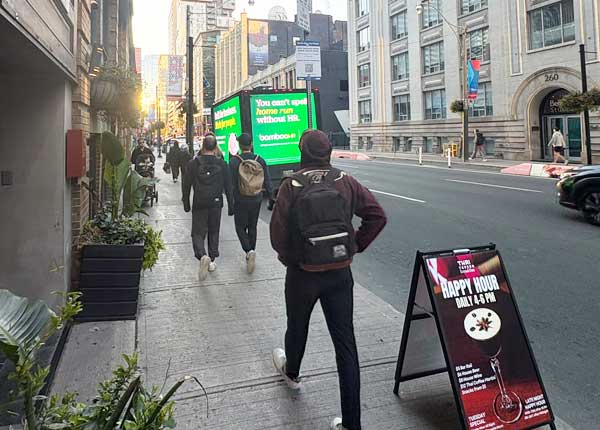
A mobile LED billboard is a vehicle equipped with digital advertising screens that display promotional content while travelling through selected routes or operating at approved stationary locations.
Unlike a traditional billboard, it is not restricted to a single advertising site.
A mobile LED truck can support a campaign across several neighbourhoods, shopping districts, business centres or event locations during the same day.
For example, a business promoting a grand opening in Toronto could schedule advertising around downtown shopping corridors, nearby commercial areas and high-traffic locations relevant to its audience.
At Grow More Technology Group, our mobile LED billboard trucks feature three digital screens:
- Two side-facing LED screens measuring approximately 3 m × 2 m, with 1280 × 720-pixel creative specifications.
- One rear-facing LED screen measuring approximately 2 m × 2 m, with 720 × 720-pixel creative specifications.
- Video-capable side screens, with audio available for suitable campaigns.
- GPS-tracked campaign routes and estimated opportunity-to-see reporting.
Campaigns can combine roaming advertising, approved stationary displays and event-focused scheduling.
Best advantage: Geographic flexibility and the ability to concentrate advertising activity around selected locations and times.
Main limitation: Visibility depends on the campaign’s operating hours, route, traffic conditions and where audiences are present.
Traditional Static Billboards
Traditional billboards use printed or vinyl advertising displayed at a fixed roadside or commercial location.
A well-positioned static billboard can reach commuters repeatedly over several weeks or months.
This makes static billboards useful for businesses that want consistent exposure in one geographic area.
However, advertisers cannot relocate the billboard when an event changes location or a different neighbourhood becomes a priority.
Changing the creative may also involve printing and installation expenses.
Best advantage: Continuous presence at a known location.
Main limitation: Fixed geographic coverage and potentially longer booking commitments.
Fixed Digital Billboards
Fixed digital billboards use electronic screens installed at permanent locations, often near busy intersections, highways, shopping areas or entertainment districts.
They can display different advertisements throughout the day.
Unlike printed billboards, creative can often be updated digitally, and advertisers may be able to purchase specific time slots or rotating shares.
However, the screen remains in one location.
Best advantage: Digital flexibility at an established high-traffic site.
Main limitation: Limited geographic mobility and possible competition for screen time.
Google Search Advertising
Google Search Ads place sponsored results in front of people searching for relevant products or services.
For example, someone searching for “new townhomes near Whitby” may already be actively researching a home purchase.
That makes search advertising valuable for capturing existing demand.
However, advertisers compete for keywords, and the cost of attracting each visitor varies by industry, competition and campaign quality.
Best advantage: Reaching customers with demonstrated search intent.
Main limitation: Competitive click costs and dependence on people actively searching.
Facebook and Instagram Advertising
Social media advertising allows businesses to deliver image, video and other advertising formats to selected audiences.
Campaigns can be optimized for objectives such as awareness, website visits, enquiries and conversions.
Social platforms are particularly useful for testing multiple messages and encouraging online interaction.
However, online impressions do not necessarily translate into meaningful attention, enquiries or sales.
Best advantage: Flexible audience targeting, creative testing and online performance reporting.
Main limitation: Ad competition, creative fatigue and incomplete visibility into some offline customer actions.

2. Mobile Billboard vs Static Billboard vs Online Ads: Advertising Costs in Canada
Price is often the first consideration when comparing advertising channels.
But comparing one day of mobile advertising with one month of static advertising is not an equal comparison.
The formats deliver different benefits, operating hours, geographic coverage and measurement capabilities.
Typical Outdoor Advertising Cost Ranges
The following are indicative Canadian advertising ranges published in Grow More’s existing billboard cost guides. Actual quotes vary by market, inventory, campaign duration and supplier.
| Advertising format | Indicative cost | Typical buying structure |
|---|---|---|
| Mobile LED billboard truck | CAD $1,200–$3,000/day | Daily or multi-day campaign |
| Traditional static billboard | CAD $500–$7,000+/month | Monthly placement |
| Fixed digital billboard | CAD $5,000–$15,000+/month | Monthly or scheduled digital inventory |
| Google Search Ads | Auction-based | Pay per click |
| Facebook and Instagram Ads | Auction-based | Impression, click or outcome-based optimization |
The billboard ranges are planning references, not guaranteed market-wide prices. Online advertising does not have one reliable universal daily rate.
For a detailed breakdown of mobile truck rates, visit our Mobile Billboard Advertising Cost in Canada guide.
What Can a $5,000 Advertising Budget Actually Buy?
Consider a Canadian business with CAD $5,000 available for advertising.
The following examples are illustrative budget scenarios, not forecasts of results.
Option A: Mobile LED billboard advertising
At an assumed campaign rate of $1,600 per day, the business could purchase three eight-hour campaign days for $4,800 before applicable taxes or additional expenses.
That provides 24 hours of planned mobile advertising, with the ability to schedule different routes or concentrate activity around an event.
Option B: Traditional static billboard
The business could seek a fixed billboard placement within its budget, subject to the location’s quoted rental rate, production charges and minimum booking term.
The benefit would be continuous exposure at one site rather than movement between several areas.
Option C: Google Search Ads
With a $5,000 media budget and an assumed average cost per click of $5, the campaign could generate approximately 1,000 paid clicks.
This is a mathematical illustration, not a Canadian CPC benchmark or a guarantee of traffic.
Actual clicks and conversions depend on keyword competition, search demand, ad quality, website performance and other factors.
Option D: Social Media Advertising
The business could allocate $5,000 toward Facebook or Instagram advertising, testing different creatives and audiences.
The number of impressions, clicks and enquiries would depend on the platform’s auction, audience size, campaign objective and creative performance.
The Important Difference
A mobile billboard budget buys scheduled physical advertising activity across selected locations.
A static billboard budget buys visibility at a particular site for a defined period.
An online advertising budget purchases media delivery through an auction-based system.
These are different products. The lowest price does not automatically represent the greatest value.
3. Reach vs Impressions: Are We Comparing the Same Numbers?
One of the biggest mistakes in advertising comparisons is treating every impression as identical.
A billboard impression, Google Ads impression and social media impression can represent very different forms of exposure.
What Is an Outdoor Advertising Impression?
Outdoor advertising impressions generally estimate opportunities for audiences to encounter or notice an advertising display, depending on the measurement methodology.
For mobile LED billboard campaigns, route location, traffic conditions, operating hours and audience movement can influence estimated exposure.
GPS records can verify where a vehicle travelled, but GPS alone does not prove that a person looked at an advertisement.
This distinction matters.
What Is an Online Advertising Impression?
An online impression is generally a platform-recorded instance of an advertisement being served or displayed according to that platform’s reporting rules.
It does not necessarily mean that a person paid attention to the advertisement or took action.
Reach, Frequency and Impressions
These three terms should not be confused:
- Impressions: The total number of estimated or recorded advertising exposures.
- Reach: The estimated or measured number of distinct people reached.
- Frequency: The average number of exposures per reached person.
For example, 100,000 impressions do not necessarily mean 100,000 different people saw an advertisement.
Some individuals may have encountered the same message multiple times.
This is why advertisers should ask how impressions are calculated before comparing proposals.
Read our detailed explanation: How Are Mobile Billboard Impressions Calculated?.
4. CPM vs ROI: Which Measurement Actually Matters?
Cost per thousand impressions, or CPM, is commonly used to compare the cost of advertising exposure.
The basic formula is:
CPM = (Campaign Cost ÷ Impressions) × 1,000
For example, assume a campaign costs $4,800 and generates 150,000 estimated advertising impressions.
CPM = ($4,800 ÷ 150,000) × 1,000
Illustrative CPM: $32
This calculation is useful for understanding cost relative to estimated exposure.
However, the result is only as reliable as the impression estimate used.
It also does not tell us how many people contacted the business or made a purchase.
What Is Advertising ROI?
Return on investment evaluates the financial return relative to advertising expenditure.
A simplified advertising ROI calculation is:
Advertising ROI = [(Incremental Profit Attributable to Advertising − Campaign Cost) ÷ Campaign Cost] × 100
Suppose a campaign costs $5,000 and generates $8,000 in additional attributable profit before advertising costs.
ROI = [($8,000 − $5,000) ÷ $5,000] × 100
Illustrative ROI: 60%
This example is hypothetical and assumes the additional profit has been properly attributed to the campaign.
In practice, advertisers should also account for production, agency fees, discounts, sales costs and other relevant expenses.
Why CPM Alone Can Be Misleading
A campaign delivering inexpensive impressions may reach people who have no interest in the product.
A more expensive campaign may reach fewer people but produce better-quality enquiries.
For example, a real estate developer promoting homes in a specific community may place greater value on reaching prospective buyers near relevant shopping areas and residential neighbourhoods than on generating the largest possible number of impressions anywhere in the province.
The objective is not simply to buy impressions. It is to create valuable advertising exposure that supports business results.
5. Real Canadian Campaign Example: Home Development Reports 5× Normal Weekend Sales
Advertising comparisons become more meaningful when connected to real business outcomes.
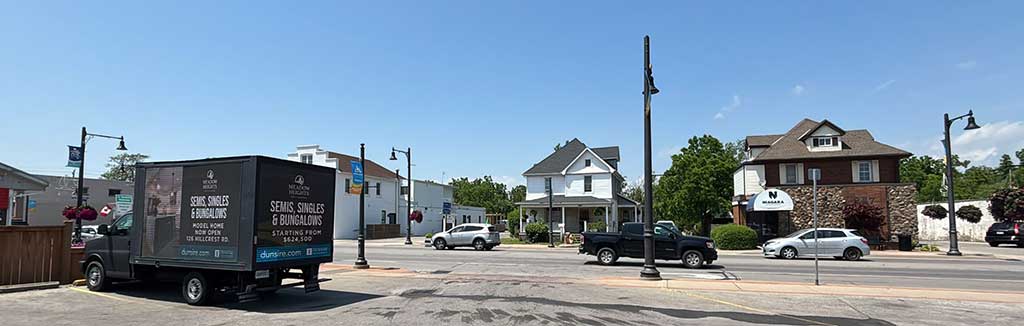
Grow More Technology Group supported a residential real estate advertising campaign in Ontario promoting newly available townhomes and detached homes.
The campaign used mobile LED billboard advertising in Brooklin and around the St. Jacobs Market area, with messaging encouraging prospective homebuyers to visit and tour homes during the weekend.
The mobile campaign allowed advertising activity to be scheduled around selected locations and shopping activity rather than relying exclusively on a permanent roadside display.
What Did the Client Report?
Following the activation, the client praised the truck team’s execution and reported that weekend sales were five times their normal level.
This was a client-reported result, not an independently audited sales study.
The fivefold figure describes the client’s reported sales performance during the relevant weekend. It does not establish how much of the increase was directly caused by mobile billboard advertising.
Other factors, including existing marketing, buyer demand, promotional activity and market conditions, may have contributed.
Why This Example Matters
For a home developer, campaign success may involve more than website clicks.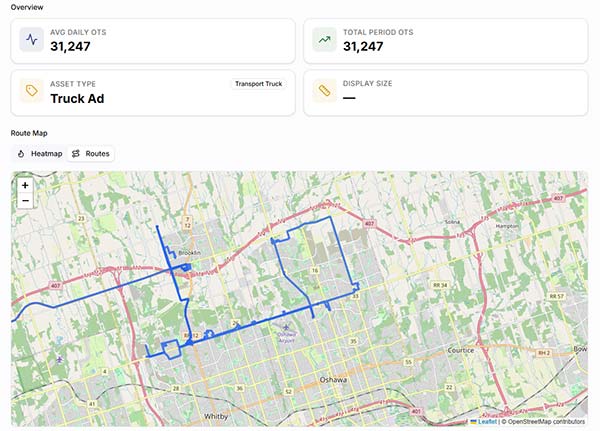
Relevant objectives can include:
- Generating awareness of a residential development.
- Promoting weekend model-home tours.
- Encouraging prospective buyers to visit a sales centre.
- Supporting sales enquiries and appointments.
- Increasing local visibility during important selling periods.
A mobile billboard campaign can support these objectives by delivering advertising in selected physical locations.
The client-reported outcome is encouraging, but it should not be interpreted as a guaranteed result or a calculated advertising ROI.
The lesson: Evaluate advertising through a combination of campaign delivery evidence, customer response and business outcomes — not impression totals alone.
6. When Mobile Billboard Advertising Makes More Sense
Mobile LED billboard advertising can be particularly useful when timing and location are central to a campaign.
Grand Openings and Store Launches
A new restaurant, retail store or showroom needs to attract attention near its location.
A mobile LED truck can travel through selected surrounding areas and promote the opening during key shopping hours.
Concerts, Festivals and Sporting Events
Large events create concentrated audience activity around particular venues and entertainment districts.
Mobile advertising can be scheduled around suitable access routes and nearby commercial corridors, subject to local operating and parking restrictions.
For event-focused campaigns, the ability to adjust schedules and routes may be more valuable than continuous exposure at one fixed site.
Real Estate Developments
Residential developers can promote new releases, model-home tours and sales events across selected communities.
Campaign routes can be designed around relevant neighbourhoods, retail centres and event locations.
Community Awareness Campaigns
Mobile billboard trucks can also support public awareness initiatives by distributing messages across several neighbourhoods during a defined campaign period.
Short-Term Promotions
When a business has only a few days to promote a sale, product launch or special event, mobile advertising offers a concentrated physical visibility option without requiring a long-term fixed placement.
7. When Static Billboards or Online Ads May Be the Better Choice
Mobile advertising is not automatically the right choice for every business.
Choose Static Billboards When You Need Long-Term Visibility
If your business wants to maintain awareness along the same commuter route for several months, a traditional static billboard may be more practical.
A strong fixed location can provide consistent exposure without daily route planning.
Choose Fixed Digital Billboards for a Specific Premium Location
If a particular intersection or commercial corridor is central to your advertising strategy, a fixed digital screen may provide the location consistency and creative flexibility you need.
Choose Google Ads When Customers Are Already Searching
A plumbing company seeking emergency service calls may benefit more directly from appearing when customers search for urgent plumbing assistance.
Google Search Ads can connect businesses with people expressing immediate purchase or service intent.
Choose Social Media Advertising When Testing Audiences and Offers
A business selling products online may need to test different audiences, messages and creative formats before scaling its advertising.
Social media advertising offers campaign optimization and online conversion reporting that outdoor advertising cannot replicate on its own.
The best media choice follows the customer journey, not the advertiser’s preferred format.
8. The Stronger Strategy: Combine Mobile Billboards With Online Advertising
Outdoor and online advertising do not need to compete.
They can support different stages of the same campaign.
Consider a residential developer launching a new community.
Stage 1: Build Local Awareness
Use a mobile LED billboard truck to promote the development in selected neighbourhoods and high-traffic areas.
Stage 2: Capture Active Interest
Run Google Search Ads for relevant homebuyer searches.
Stage 3: Encourage Further Engagement
Use social media campaigns to showcase floor plans, home features and upcoming tour opportunities.
Stage 4: Measure Customer Response
Track website enquiries, calls, scheduled visits and qualified sales appointments.
Where legally permitted and supported by appropriate consent and privacy practices, additional digital audience strategies may also be considered.
However, marketers should not assume that everyone passing a mobile billboard can be identified or retargeted.
How to Measure an Integrated Campaign
Use consistent reporting across channels wherever possible.
Useful measurements include:
-
Outdoor campaign dates and GPS route records.
-
Estimated outdoor advertising exposure.
-
Website traffic and landing-page enquiries.
-
Calls, appointments and qualified leads.
-
Sales outcomes and customer acquisition costs.
-
Customer-reported sources of awareness.
Tracking links, dedicated phone numbers, promotional codes and customer surveys can provide additional evidence.
No single measurement method provides a complete picture of every customer interaction.
9. How Grow More Measures Mobile Billboard Campaign Delivery
Grow More Technology Group provides mobile LED billboard advertising services across Canada, supporting campaigns in markets including Toronto, Vancouver, Calgary, Edmonton, Ottawa, Montreal and other communities.
Campaigns are planned around client objectives, geographic requirements and operating conditions.
A standard campaign can include an eight-hour advertising day, with options for longer or multi-day deployments.
What Clients Can Expect
GPS-tracked routes
Campaign routes can be documented to show where the advertising vehicle operated.
Estimated opportunity-to-see reporting
Estimated exposure figures can help advertisers understand potential audience delivery along campaign routes.
These are estimates, not verified counts of people who watched an advertisement.
Campaign photographs
Photographs provide visual documentation of the creative displayed and campaign execution.
Flexible scheduling
Routes and schedules can be planned around target areas, business hours and event activity.
End-of-campaign reporting
Campaign documentation helps clients review execution and evaluate the advertising activity alongside their own business performance data.
For more information on planning campaign hours, creative delivery and reporting, read How to Plan an 8-Hour Mobile Billboard Advertising Campaign in Canada.
10. Which Advertising Format Should Your Business Choose?
Before committing your budget, answer five questions.
1. What is your primary goal?
Brand awareness, event attendance, enquiries, store visits and online purchases require different advertising strategies.
2. Where is your audience?
Are potential customers concentrated around physical locations, travelling along specific corridors or actively searching online?
3. How quickly do you need results?
A three-day event promotion requires a different media schedule from a six-month brand awareness campaign.
4. What can you measure?
Determine whether your priority is estimated reach, website visits, qualified enquiries, appointments or actual sales.
5. What is your complete budget?
Consider production, media placement, operating costs, agency fees, tracking and any additional expenses.
Our Recommendation
For short-term promotions requiring strong local visibility and geographic flexibility, mobile LED billboard advertising deserves serious consideration.
For continuous presence at one established location, traditional or fixed digital billboards may be a better fit.
For capturing existing online demand and measuring digital conversions, Google and social media advertising offer important advantages.
For campaigns that need both physical visibility and online response, a coordinated combination can be worth testing.
Frequently Asked Questions
Is a mobile billboard better than a static billboard?
A mobile billboard offers flexible geographic coverage and event-focused scheduling, while a static billboard provides consistent exposure at one location. The better choice depends on the campaign’s objectives, duration and target audience.
How much does mobile billboard advertising cost in Canada?
Grow More’s published Canadian mobile LED billboard pricing generally ranges from CAD $1,200 to $3,000 per day, depending on the city, campaign duration, operating hours and requirements.
Is mobile billboard advertising more effective than Google Ads?
Neither channel is universally more effective. Mobile billboards can support physical brand awareness and location-specific promotions, while Google Search Ads are particularly useful for reaching customers actively searching for products or services.
How do you calculate mobile billboard advertising ROI?
Calculate the incremental profit attributable to the campaign, subtract the total campaign cost, divide by the campaign cost and multiply by 100. Estimated impressions alone cannot establish ROI.
Can mobile billboards increase real estate sales?
Mobile billboard advertising can support real estate marketing by promoting developments, sales events and home tours. Grow More has received client feedback reporting weekend sales at five times normal levels following an Ontario residential campaign, although the advertising’s individual contribution was not independently established.
Can mobile billboard advertising and social media ads work together?
Yes. Mobile billboards can create physical awareness in selected locations, while social media advertising can support digital engagement, website traffic and lead generation. Both channels can be evaluated against shared campaign objectives.
How are mobile billboard impressions tracked?
Mobile billboard campaign reporting may combine GPS route data, operating schedules, traffic information and opportunity-to-see estimates. GPS tracking verifies vehicle movement, but it does not independently verify that every estimated audience member viewed the advertisement.
Which advertising method is best for a small business?
A small business should choose based on its target customers, budget and desired outcome. Google Ads may be suitable for capturing active searches, static billboards for sustained local awareness, and mobile LED billboards for concentrated promotions, openings and events.
Final Thoughts: Better Advertising Decisions Start With Better Measurement
Planning an advertising campaign in Canada?
Not sure whether a mobile LED billboard, static billboard or online advertising is the right investment? Grow More Technology Group can help you evaluate your campaign objectives, target locations, operating hours and budget. Request a customized mobile billboard advertising quote and discover how GPS-tracked mobile advertising can support your next campaign.