
Businesses today have more ways to advertise than ever.
Google Ads. Social media. Display advertising. Email. Influencers. Billboards. Digital out-of-home displays. Mobile LED billboard trucks.
With so many choices, one question comes up often:
Outdoor advertising vs digital marketing — which one should your business use?
The answer isn’t always one or the other.
Outdoor advertising puts your brand into the physical world, where people live, commute, shop, attend events and spend their time. Digital marketing reaches people through the devices and platforms they use throughout the day.
Each has different strengths.
And increasingly, brands are combining the two.
At Grow More Technology Group, we see this convergence firsthand through mobile LED billboard campaigns, location-based advertising, geofencing and digital retargeting.
Here is how outdoor advertising and digital marketing compare — and how businesses can decide where each fits into their advertising strategy.
Outdoor Advertising vs Digital Marketing: Quick Comparison
| Factor | Outdoor Advertising | Digital Marketing |
|---|---|---|
| Where people see it | Streets, neighbourhoods, events, retail areas and public spaces | Phones, computers, apps, websites and digital platforms |
| Geographic targeting | Strong | Strong |
| Audience targeting | Location and environment focused | Detailed demographic, interest and behavioural targeting |
| Physical visibility | Very strong | Limited to screens/devices |
| Clickable | No | Yes |
| Ad blocking | Generally not applicable | Possible |
| Real-world event presence | Strong | Limited |
| Creative flexibility | Static, digital or video depending on format | Images, video, search, social, display and interactive formats |
| Measurement | Traffic, routes, estimated impressions and campaign reporting | Clicks, impressions, conversions, CPC, CPM and other platform metrics |
| Retargeting | Possible when integrated with location-based technology | Strong |
| Best use | Awareness, visibility, launches, events and geographic campaigns | Targeting, engagement, lead generation, ecommerce and conversion |
The biggest difference is simple:
Outdoor advertising reaches people in physical environments. Digital marketing reaches them through digital environments.
Modern advertising strategies can connect both.
What Is Outdoor Advertising?
Outdoor advertising, commonly called out-of-home advertising (OOH), is advertising people encounter while they are outside their homes.
Traditional examples include:
- Static billboards
- Transit advertising
- Bus shelters
- Street furniture
- Posters
- Building displays
- Digital billboards
Modern outdoor advertising also includes digital out-of-home advertising (DOOH) and mobile digital out-of-home advertising, including mobile LED billboard trucks.
Instead of waiting for an audience to pass one fixed billboard, a mobile billboard can move through selected neighbourhoods, commercial districts, event areas and high-traffic streets.
That mobility changes how outdoor advertising can be planned.
What Is Digital Marketing?
Digital marketing reaches audiences through internet-connected devices and platforms.
Common examples include:
- Google search advertising
- Social media advertising
- Display advertising
- Video advertising
- Email marketing
- Search engine optimization
- Content marketing
- Influencer marketing
- Geofencing
- Digital retargeting
Its major advantage is targeting.
A campaign can potentially be narrowed according to location, demographics, interests, search behaviour, previous website activity and other available audience signals.
Digital platforms can also provide detailed performance metrics, including impressions, clicks, cost per click, website activity and conversions.
But digital marketing happens in an extremely crowded environment.
Your advertisement is competing against messages, videos, notifications, search results, emails and countless other pieces of content.
Outdoor advertising approaches attention differently.
It puts the brand directly into the environment.
Outdoor Advertising vs Digital Marketing: 6 Key Differences
1. Visibility and Attention
One of outdoor advertising’s biggest strengths is physical scale.
A large billboard, digital display or mobile LED billboard truck occupies real space.
People don’t need to open an app, visit a website or search for a business before encountering the message.
Mobile LED displays add another dimension: movement.
A bright digital advertising truck travelling through downtown streets, entertainment districts or around an event naturally becomes part of the surrounding environment.
Digital advertising offers enormous reach, but that exposure happens on much smaller screens and in environments where people can scroll past advertisements quickly.
For campaigns where visibility and brand awareness are the priority, outdoor advertising can play a powerful role.
2. Audience Targeting
Digital marketing has an obvious advantage when highly specific audience targeting is required.
Depending on the platform and applicable privacy rules, advertisers can target audiences based on factors such as geography, interests, behaviour or previous interactions.
Outdoor advertising traditionally relies more heavily on location and audience context.
For example, a campaign might target:
- Downtown commuters
- University areas
- Shopping districts
- Convention attendees
- Sports audiences
- Festival crowds
- Specific neighbourhoods
- Business districts
Mobile outdoor advertising makes geographic targeting more flexible because the advertising unit itself can move.
Instead of purchasing one fixed location, a mobile billboard route can be developed around the places and times most relevant to the campaign.
3. Engagement
Digital advertisements have an important advantage: people can interact with them immediately.
They can click.
Visit a website.
Fill out a form.
Download an app.
Buy a product.
Outdoor advertisements work differently.
Their role is often to create awareness, recognition and recall before the audience takes another action.
That’s why simple calls to action work particularly well on mobile billboard creative:
Visit the website.
Search the brand.
Scan the QR code when the truck is stationary.
Visit the store nearby.
Attend the event.
Outdoor can create the first impression while digital channels provide the next step.
4. Geographic Flexibility
A traditional billboard stays in one location.
A mobile billboard doesn’t have to.
A Grow More mobile LED truck can operate through multiple areas during a campaign day, allowing brands to adjust routes around their audience.
For example, a campaign could spend part of the day around a business district, move toward a retail area during the afternoon and operate around an entertainment or event district later in the day.
That makes mobile billboard advertising particularly useful for:
- Product launches
- Store openings
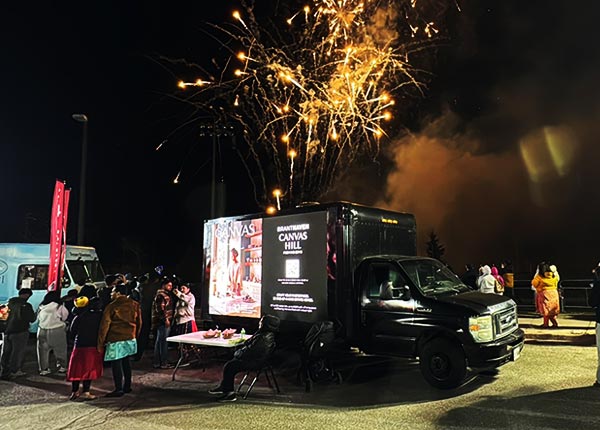
- Festivals
- Conferences
- Trade shows
- Sporting events
- Movie promotions
- Tourism campaigns
- Community awareness campaigns
Routes must always account for local traffic, stopping, parking and advertising regulations.
5. Measurement
Measurement is one of digital marketing’s greatest strengths.
Digital campaigns can provide metrics such as:
- Impressions
- Click-through rates
- Cost per click
- Website sessions
- Leads
- Purchases
- Conversion rates
Outdoor measurement is different.
For Grow More mobile billboard campaigns, reporting can include GPS route information, campaign photos and estimated impression counts based on campaign conditions and available traffic/audience data.
These numbers should be treated as estimates rather than guaranteed unique viewers or conversions.
Additional campaign indicators can include:
- Website traffic changes
- Branded search activity
- QR code scans
- Promotional code usage
- Store visits
- Event attendance
- Lead activity
The strongest measurement strategy depends on the campaign objective.
6. Cost
Comparing outdoor advertising and digital marketing purely by price can be misleading because the two channels are purchased differently.
Digital campaigns may be purchased using metrics such as cost per click (CPC), cost per thousand impressions (CPM), cost per acquisition (CPA) or an overall campaign budget.
Outdoor advertising is commonly priced according to factors such as location, format, campaign duration and market demand.
For mobile LED billboard advertising in Canada, Grow More campaigns generally fall around:
$1,200–$3,000 CAD per campaign day
depending on the market, campaign duration, travel requirements, number of trucks, major events and other operational requirements.
Longer campaigns and multi-truck bookings may be structured differently.
Rather than asking only, “Which channel costs less?”, advertisers should ask:
What result are we trying to create?
If the objective is online conversion, digital advertising may carry more of the workload.
If the objective is high-impact local visibility, outdoor advertising may deserve a larger role.
And when both awareness and follow-up matter, an integrated campaign becomes especially interesting.
The Missing Middle: Digital Out-of-Home Advertising
The line between outdoor advertising and digital marketing is becoming less clear.
That’s because of digital out-of-home advertising (DOOH).
DOOH uses digital screens in physical environments.
That can include:
- Digital billboards
- Digital street displays
- Retail screens
- Transit displays
- Venue screens
- Mobile LED billboard trucks
Mobile LED advertising adds mobility to DOOH.
Instead of displaying one static advertisement at one location, brands can run video and changing creative while taking the campaign into selected areas.
Grow More’s mobile LED billboard trucks feature three LED advertising screens, including two large video-enabled side displays and a rear display, allowing campaigns to run high-visibility digital creative while moving or operating from approved stationary locations.
This creates something that sits between traditional outdoor advertising and modern digital media.
Mobile Billboard Advertising + Digital Marketing
This is where outdoor and digital advertising become much more interesting.
Imagine a campaign structured like this:
Step 1: Mobile LED Billboard
A mobile LED truck creates physical visibility throughout selected campaign areas.
↓
Step 2: Geographic Audience Strategy
The campaign operates around locations where the target audience is likely to be present.
↓
Step 3: Geofencing
Where appropriate and compliant with applicable privacy and platform requirements, location-based advertising technology can help build or reach relevant audiences associated with selected geographic areas.
↓
Step 4: Digital Retargeting
Eligible audiences can potentially receive follow-up advertising through supported digital channels.
↓
Step 5: Measurement
GPS reporting, estimated outdoor impressions and available digital campaign metrics can provide a broader picture of campaign activity.
The billboard doesn’t have to represent the end of the advertising journey.
It can be the beginning.
Outdoor Gets Attention. Digital Continues the Conversation.
Consider someone who sees a mobile LED billboard while walking downtown.
They notice the brand but don’t immediately take action.
Later, they encounter the same brand online.
Now the name looks familiar.
That combination of physical exposure + digital reinforcement can create a more connected advertising experience.
This is particularly useful when brands want both broad local visibility and opportunities for subsequent digital engagement.
When Should You Choose Outdoor Advertising?
Outdoor advertising can be particularly useful when your objective includes:
- Building brand awareness
- Reaching audiences in a specific geographic area
- Creating visibility around an event
- Supporting a store opening
- Launching a new product
- Promoting entertainment
- Reaching convention or trade-show attendees
- Building presence within a city
- Creating highly visible public-facing campaigns
Mobile billboard advertising becomes especially relevant when the target audience isn’t concentrated around one fixed billboard location.
When Should You Choose Digital Marketing?
Digital marketing may be more suitable when your campaign depends heavily on:
- Website conversions
- Ecommerce purchases
- Lead generation
- Detailed audience segmentation
- Search intent
- App downloads
- Online registrations
- Immediate clicks
- Conversion tracking
For many businesses, digital advertising should remain an important part of the marketing mix.
The question is whether digital needs to work alone.
When Should You Use Both?
Consider combining outdoor and digital advertising when your campaign needs:
Awareness + action
Physical presence + online engagement
Local visibility + audience targeting
Event exposure + follow-up
Brand recognition + measurable digital activity
A product launch is a good example.
A mobile LED billboard can build visibility around the launch location and surrounding neighbourhoods.
Social, search or display advertising can reinforce the campaign online.
Location-based advertising may provide another layer of audience reach where appropriate.
Instead of expecting one channel to do everything, each channel performs the job it does best.
Real-World Mobile Billboard Advertising in Canada
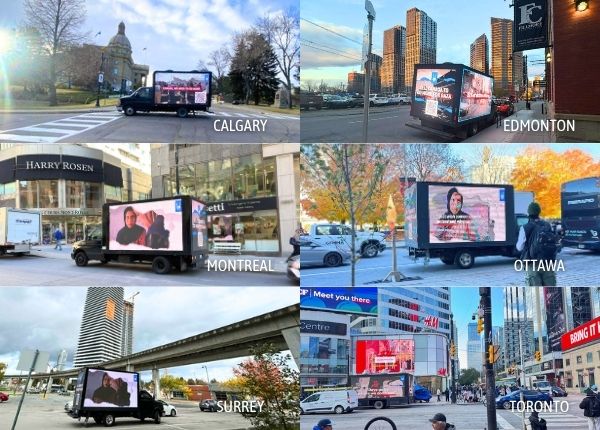
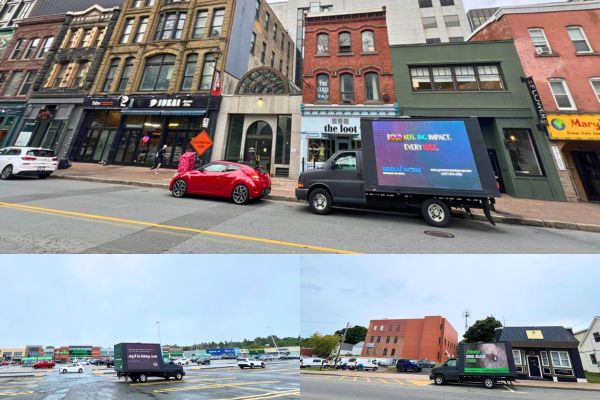
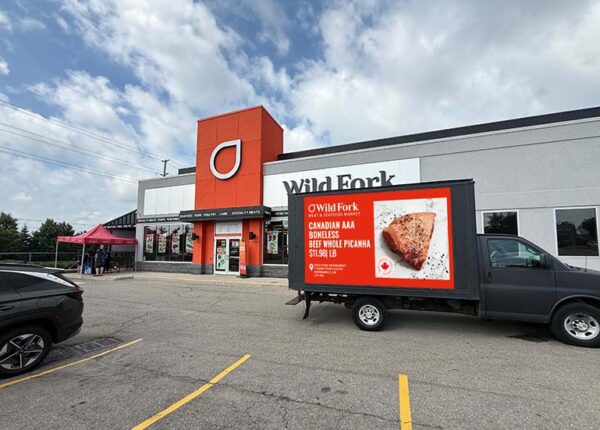
Grow More has used mobile LED billboard advertising across a wide range of Canadian campaign environments, including tourism promotions, sporting events, movie promotions, retail openings, festivals, conferences, trade shows and community campaigns.
Those experiences reinforce an important point:
Context matters in outdoor advertising.
The same truck can serve very different objectives depending on its route, timing, creative and campaign strategy.
A tourism campaign operating through busy downtown areas has different requirements from a retail opening.
A movie campaign around an entertainment district has different objectives from a trade-show campaign targeting attendees near a convention venue.
That’s why mobile billboard advertising should not simply mean putting a truck on the road.
Route + timing + creative + audience + measurement should work together.
Outdoor Advertising vs Digital Marketing: Which Is Better?
Neither channel is universally better.
They solve different problems.
Choose outdoor advertising when physical visibility, geographic presence and broad real-world awareness are important.
Choose digital marketing when detailed audience targeting, online interaction and conversion measurement are priorities.
Use outdoor + digital together when you want physical exposure to create awareness and digital channels to continue the customer journey.
For modern campaigns, that third option is becoming increasingly valuable.
Why Grow More?
Grow More Technology Group provides mobile LED billboard advertising across Canada, helping brands take their campaigns directly into the streets, neighbourhoods, event districts and commercial areas where their audiences are active.
Campaign capabilities can include:
- Mobile LED billboard trucks
- Video and image advertising
- Route planning
- GPS campaign reporting
- Daily campaign photos
- Estimated impression reporting
- Geofencing strategies
- Digital retargeting
- Multi-city and nationwide campaign coordination
Whether you’re planning a one-city activation or a larger Canadian campaign, the objective remains the same:
Put your message where people can see it — and build a strategy around what happens next.
Recent Blogs

Frequently Asked Questions
Is outdoor advertising better than digital marketing?
Neither is universally better. Outdoor advertising is particularly strong for physical visibility, geographic awareness and public presence, while digital marketing offers detailed targeting, interaction and online conversion measurement. Many campaigns can benefit from combining the two.
What is the difference between outdoor advertising and digital marketing?
Outdoor advertising reaches audiences in physical public environments through formats such as billboards, transit displays and mobile LED trucks. Digital marketing reaches audiences through websites, search engines, social platforms, apps, email and other digital channels.
Is digital billboard advertising considered digital marketing?
Digital billboards are generally classified as digital out-of-home advertising (DOOH). They use digital technology but operate in physical environments, making DOOH a bridge between traditional outdoor media and digital advertising.
How much does mobile billboard advertising cost in Canada?
Mobile LED billboard campaigns in Canada commonly vary according to the city, duration, campaign requirements, travel and event demand. Grow More’s general campaign range is approximately $1,200–$3,000 CAD per campaign day, with custom pricing available for longer and multi-truck campaigns.
Can outdoor advertising be combined with digital retargeting?
Yes. Depending on the campaign, platform capabilities, consent requirements and applicable privacy rules, location-based advertising and digital retargeting can complement an outdoor campaign and help extend engagement beyond the initial physical exposure.
Can mobile billboard advertising be measured?
Mobile billboard campaigns can use GPS route reporting, campaign photography and estimated impression reporting. Advertisers can also monitor indicators such as website activity, branded searches, QR scans, promotional codes and other campaign-specific actions.
What businesses benefit from mobile billboard advertising?
Mobile billboards can support retailers, entertainment companies, tourism organizations, event organizers, real estate companies, consumer brands, restaurants, agencies and organizations running geographic awareness campaigns.
What is DOOH advertising?
DOOH stands for digital out-of-home advertising. It refers to digital advertising screens located in public environments, including digital billboards, retail displays, transit screens and mobile LED billboard trucks.
Final Takeaway
The debate shouldn’t always be outdoor advertising vs digital marketing.
A better question is:
How can outdoor and digital work together?
Outdoor advertising can put your brand into the real world.
Digital marketing can continue the interaction online.
Mobile DOOH, geofencing and retargeting increasingly connect those two environments.
For brands looking for both visibility and follow-through, the future isn’t necessarily outdoor or digital.
It’s connected advertising.