
Election Advertising in Canada: How Mobile Billboard Trucks Put Campaign Messages on the Move
Quick answer: Mobile billboard election advertising uses GPS-tracked LED trucks to carry campaign messaging through targeted neighbourhoods, commercial corridors, and high-traffic routes — instead of waiting at one fixed location. In Canada, mobile LED truck campaigns typically run $1,200–$3,000/day, with creative that can be swapped mid-campaign as priorities shift. Grow More operates GPS-tracked trucks in 70+ Canadian cities with daily route reporting.
A campaign has one deadline. Everything else is negotiable — the message, the budget split, the last-minute pivot after a debate — but election day doesn’t move.
That’s the problem with a lot of campaign media: lawn signs sit still, flyers get recycled, and a static billboard only works if voters happen to drive past it. None of that adapts when a campaign needs to be in three ridings this week and a different two next week.
A mobile LED billboard truck solves a narrower problem than “get more visibility.” It solves “get visibility in the specific places that matter, on the specific week that matters, with a message we can change by Thursday.”
What Is Mobile Billboard Election Advertising?
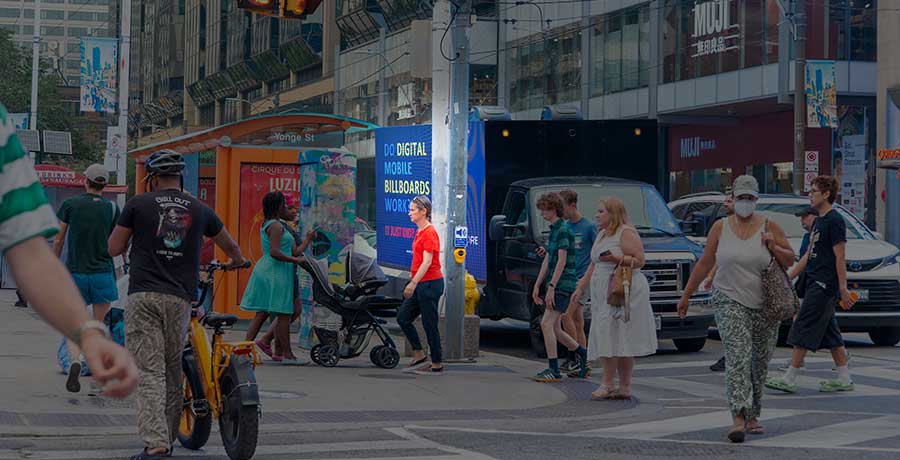
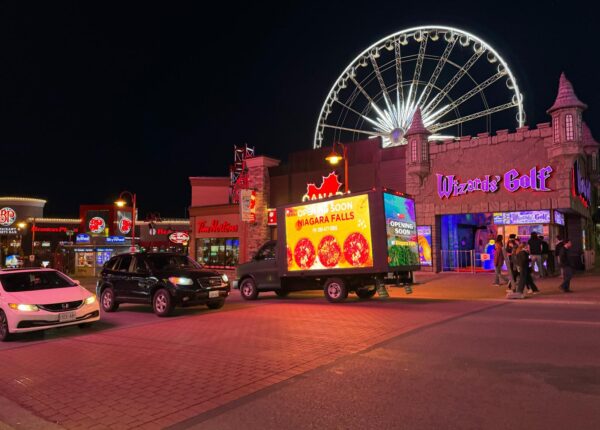
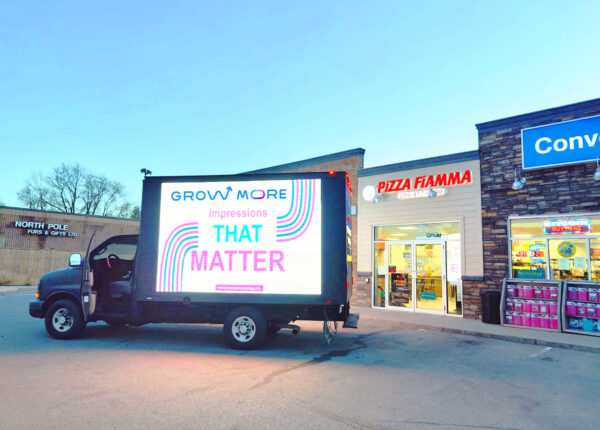
It’s advertising vehicles built around large-format LED displays, running planned routes through the areas a campaign actually cares about.
A truck can carry:
- Candidate name, photo, and core message
- Campaign slogans and platform points
- Advance-voting and election-day reminders
- Short video and motion creative
- Event announcements
- A clear next step — website, volunteer sign-up, polling info
The difference from a fixed billboard isn’t the screen. It’s that the screen moves to where the campaign decides it needs to be, and the creative on it can change faster than a print run.
Why Campaigns Use Mobile Billboards
The truck goes to the voters, not the other way around
Campaigns are won and lost riding by riding, sometimes poll by poll. A route can be built around specific wards, advance-poll locations, or neighbourhoods where a campaign is trying to move undecided voters — and adjusted the following week if the strategy shifts.
Repetition builds recognition
A voter who sees a candidate’s name on a lawn sign, then again in a social feed, then a third time on an LED screen at a busy intersection, is more likely to remember it than a voter who saw it once. The truck’s job in that mix is the loud, unmissable version — big screen, simple message, hard to scroll past.
Creative changes without reprinting anything
Lawn signs and flyers lock a message in the moment they’re printed. A digital screen doesn’t. The same truck can run:
- Week one: candidate introduction
- Week two: a platform priority
- Advance-voting week: “advance polls are open, here’s where”
- Final 48 hours: “polls close [time] — here’s your riding’s location”
One vehicle, four campaign stages, zero reprints.
High-traffic areas, on purpose
Routes can be planned around commercial strips, major arterials, transit hubs, and community gathering spots — wherever the campaign’s actual audience spends time. That’s a deliberate routing decision, not a lucky billboard location.
Trucks can also work an event, then go back to the route
A rally, a debate, a community event — a truck can sit nearby for added visibility before returning to its scheduled route. It doesn’t have to choose between “moving campaign” and “event support.”
It plugs into digital, it doesn’t compete with it
A voter who notices the truck and later searches the candidate’s name, or sees a retargeted ad from that same campaign, is the ideal outcome. The screen’s job is the interruption; digital’s job is the follow-through.
What It Costs
Mobile LED billboard campaigns in Canada generally run $1,200–$3,000 per day, depending on:
- Number of trucks and campaign length
- Route complexity (single riding vs. multi-city)
- Creative production needs (static vs. video)
- Peak-period demand — election weeks and advance-voting weeks book up fast
Campaigns booking multiple trucks across several ridings, or running through an entire election period, should expect volume-based pricing rather than a flat day rate. Get in touch for a route-specific quote.
Getting the Most Out of an Election Campaign
Know who needs to see it. A citywide campaign and a single-riding byelection need completely different routes — decide the geography before booking anything.
Keep the message to one idea per screen. A moving LED display gets a few seconds of attention. Candidate name, one message, one call to action — not a platform summary.
Plan the creative calendar in advance. Introduction, priority messaging, advance-voting reminders, election-day reminders — map the sequence before the campaign starts so screen changes aren’t a scramble in week three.
Match routing to the campaign clock. Early campaign: broad awareness routes. Final week: heavy rotation through advance-poll areas and high-density voter zones.
Confirm the rules before launch. Election advertising in Canada is regulated at the federal, provincial, and municipal level, and requirements differ by jurisdiction — authorization statements, spending disclosure, sign bylaws, and election-day restrictions all vary. Confirm applicable rules with campaign counsel before creative goes live. (Grow More provides the trucks and the routing — not legal or compliance advice.)
Election Advertising Across Canada with Grow More
Contact UsGrow More runs GPS-tracked mobile LED billboard trucks in 70+ Canadian cities, with:
Custom campaign routing by riding, ward, or region
Daily GPS reporting and route photos
Dynamic creative — swap messaging mid-campaign
Multi-truck, multi-city coordination for larger campaigns
Event-adjacent deployment alongside scheduled routes
Impressions that matter. Whether it’s a single-riding byelection or a multi-city push, we build the route around where your campaign needs to be seen — not around where a billboard happens to already be standing.
Planning an election campaign? Book early — election-period slots fill fast.
Quick FAQs
How much does election advertising cost in Canada?
Mobile LED billboard campaigns typically run $1,200–$3,000 per day, depending on truck count, route complexity, and campaign length. Multi-city or full-election-period bookings are quoted by volume.
Can the campaign message change during the election?
Yes. Unlike a printed sign, an LED truck’s creative can be updated throughout the campaign — introduction, platform messaging, advance-voting reminders, and election-day reminders can all run on the same vehicle without reprinting anything.
Is mobile billboard advertising legal for elections in Canada?
Mobile LED advertising is a legitimate outdoor media format, but election advertising itself is regulated federally, provincially, and municipally — rules around authorization statements, spending disclosure, and sign bylaws vary by jurisdiction. Campaigns should confirm requirements with their own legal counsel before launching creative.
Can trucks be routed to specific ridings or neighbourhoods?
Yes. Routes are built around whatever geography the campaign needs — a single riding, a cluster of wards, or a multi-city rollout — and can be adjusted as campaign priorities shift.